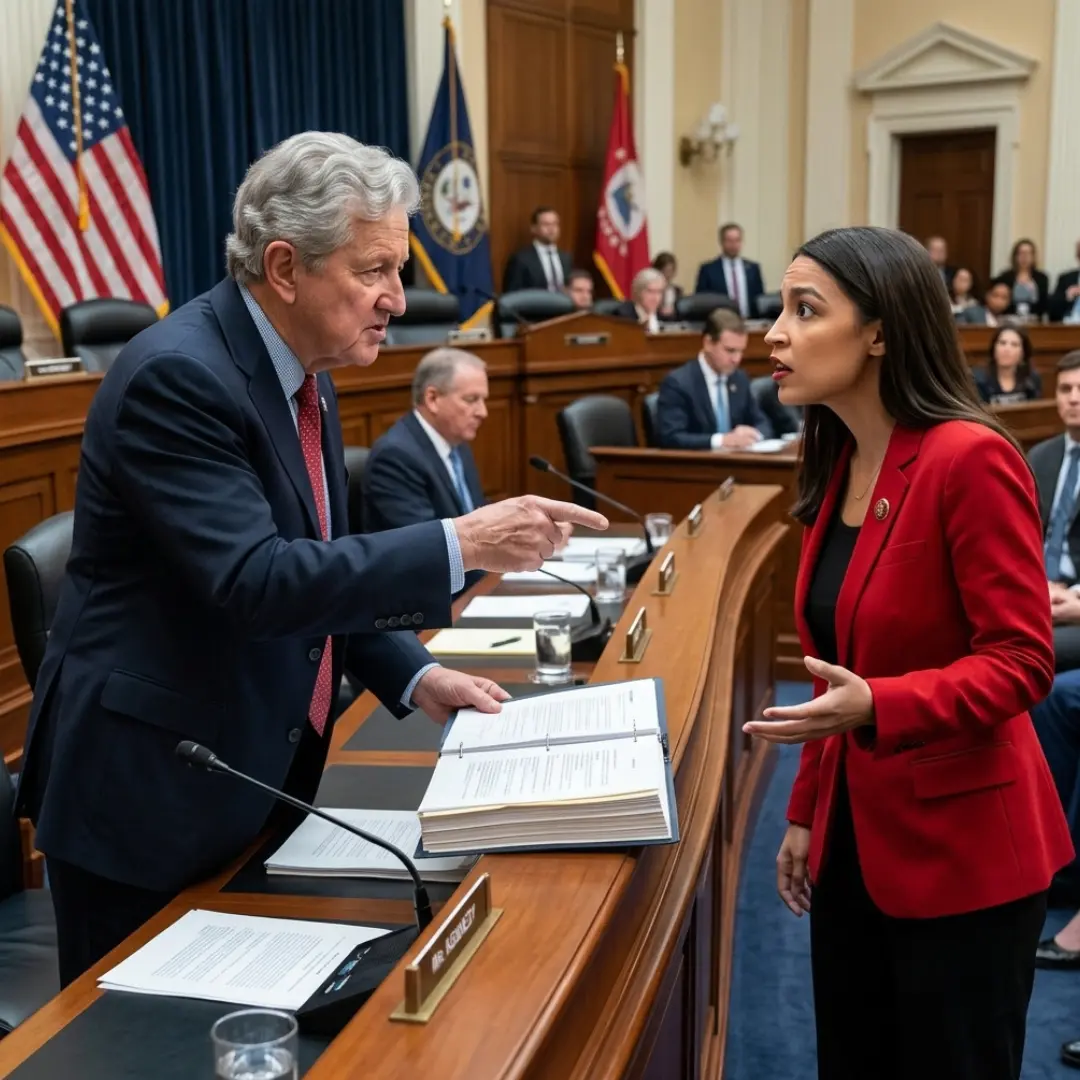
The hearing began like countless others in Washington, with lawmakers exchanging arguments about healthcare, public spending, and accountability. Nobody anticipated that a personal remark would transform the entire afternoon into confrontation.
Senator John Neely Kennedy sat quietly behind his microphone, reviewing several pages of prepared questions. Across the room, Representative Alexandria Ocasio-Cortez appeared confident, determined, and ready for another contentious policy debate.
The discussion initially concerned healthcare affordability, particularly the financial pressures facing working families. Both politicians presented sharply different interpretations of government responsibility, insurance access, and the consequences of unsuccessful reforms nationwide.
Kennedy questioned whether ambitious promises could survive complicated implementation. He argued that ordinary Americans deserved practical results rather than impressive speeches, emphasizing the difference between announcing programs and successfully delivering essential services.
Ocasio-Cortez challenged his reasoning, defending the importance of structural reform and broader public investment. Their disagreement intensified as each attempted to establish which approach would better protect financially vulnerable American families.
Then the atmosphere changed dramatically. In this imagined exchange, Ocasio-Cortez laughed at Kennedy's background, suggesting that a Louisiana farmer lacked the credentials necessary to understand the complexities of modern healthcare policy.
Several people shifted uncomfortably in their seats. The comment had moved beyond policy disagreement, introducing personal judgment into a discussion supposedly dedicated to helping Americans navigate an increasingly expensive healthcare system.
Kennedy remained motionless, his expression revealing almost nothing. Instead of responding with anger, he placed his pen beside the microphone and looked directly toward his congressional colleague across the crowded room.
His silence lasted long enough for nearby conversations to fade. Then, speaking in an unusually measured voice, Kennedy delivered a brief statement that immediately altered the emotional temperature of the hearing.
"You have three seconds to apologize," he said. The words were quiet, but their unexpected directness commanded attention. Even those reviewing documents suddenly looked up, anticipating the confrontation that would follow.
Ocasio-Cortez appeared surprised by the demand. She maintained her composure, refusing to abandon her argument, while several lawmakers exchanged uneasy glances over the increasingly personal nature of the televised discussion.
Kennedy did not interrupt or elaborate. He simply waited, allowing the silence to stretch across the chamber as cameras focused on the two politicians and spectators wondered what would happen next.
One second passed without an apology. Kennedy continued watching calmly, his hands resting on a closed folder. The audience remained silent, sensing that something more consequential than another argument was approaching.
Two seconds passed. Ocasio-Cortez adjusted her position and looked toward the committee chairman, apparently expecting the discussion to resume. Kennedy remained still, refusing to surrender the moment to ordinary procedural interruptions.
The third second ended. Kennedy lowered his gaze, reached for the folder, and carefully opened it. The deliberate movement attracted attention because he had previously left the documents completely untouched throughout questioning.
Inside the fictional folder was a purported internal review dated 2018, describing administrative weaknesses within an imagined healthcare initiative. The document existed solely within this invented scenario, not as verified evidence.
Kennedy lifted the first page and explained that policy debates should ultimately be measured by their effects on families. He suggested that personal insults offered little comfort to people struggling with medical bills.
The fictional report described complicated enrollment procedures, inconsistent communication, and delayed eligibility decisions. These imagined administrative problems created a narrative about how well-intentioned reforms can fail when implementation receives insufficient attention from officials.
Kennedy turned another page, emphasizing the difference between political ambition and operational competence. He argued that every healthcare proposal required clear accountability, transparent measurements, and reliable procedures for identifying failures before families suffered.
Ocasio-Cortez responded by questioning the document's relevance and asking whether the review represented a complete assessment. Her challenge introduced an important distinction between identifying administrative problems and assigning responsibility to individual politicians.
Kennedy acknowledged that distinction but continued presenting the imagined findings. He insisted that public officials should confront weaknesses openly, regardless of whether those weaknesses emerged from policies associated with their preferred political philosophy.
The exchange became increasingly focused on accountability rather than personality. Although the original insult remained uncomfortable, the room now concentrated on the fictional report and the competing interpretations offered by both lawmakers.
Kennedy described a hypothetical mother who had submitted insurance paperwork repeatedly while awaiting approval. In his account, administrative delays prevented her family from receiving timely information about available healthcare coverage options.
He then described an imagined retired factory worker who struggled to understand conflicting eligibility notices. The man's experience illustrated how complicated regulations can become overwhelming when agencies fail to communicate consistently.
These examples were fictional illustrations, not documented patients or verified cases. Their purpose within the dramatic hearing was to highlight the human consequences of bureaucratic confusion and poorly coordinated public programs.
Kennedy continued speaking without raising his voice. He argued that policymakers should evaluate their proposals through the experiences of ordinary citizens rather than through applause, political loyalty, or favorable headlines alone.

Ocasio-Cortez countered that isolated failures should not automatically invalidate broader reform efforts. She emphasized that healthcare systems require adequate funding, administrative capacity, and continued improvement rather than simplistic judgments about political success.
The disagreement exposed two competing approaches to evaluating government programs. Kennedy emphasized implementation failures and accountability, while Ocasio-Cortez focused on structural barriers, access to coverage, and the resources necessary for reform.
Neither politician surrendered the underlying argument. Nevertheless, the atmosphere had shifted from personal mockery toward a substantive dispute over evidence, administrative responsibility, and the meaning of successful healthcare policy in practice.
Kennedy paused before introducing another imagined section of the report. He explained that public officials should never dismiss concerns simply because the people raising them came from unfamiliar backgrounds or different communities.
The statement returned attention to the earlier remark about his Louisiana upbringing. Kennedy argued that personal experience outside Washington did not automatically disqualify someone from asking difficult questions about federal government performance.
He described farmers, mechanics, nurses, and small business owners as people whose everyday responsibilities demanded practical judgment. Their experiences, he suggested, deserved respect rather than dismissal during discussions about complicated national policies.
Ocasio-Cortez listened while preparing her response. She maintained that specialized policy knowledge mattered, but she also recognized the importance of hearing directly from communities affected by healthcare decisions and administrative failures.
The fictional chairman intervened, reminding both lawmakers that the committee's responsibility was to examine policy rather than personal character. His measured warning briefly interrupted the confrontation and restored a degree of order.
Kennedy accepted the instruction and returned to his notes. He asked whether the committee could agree that every healthcare initiative should include measurable benchmarks, independent evaluation, and accessible appeals procedures for patients.
Ocasio-Cortez answered that transparent oversight was essential, particularly when vulnerable populations depended on government assistance. She added that evaluation should also consider whether funding shortages contributed to administrative problems and service disruptions.
For a moment, the debate revealed an unexpected area of agreement. Both politicians supported accountability, even though they disagreed sharply about which policies and institutions were most responsible for delivering it effectively.
Kennedy then returned to the fictional report's central finding: administrative promises mean little without consistent execution. He argued that lawmakers should demand evidence of successful implementation before celebrating major legislative announcements.
Ocasio-Cortez challenged the assumption that implementation problems necessarily originated with reform advocates. She suggested that resistance, inadequate resources, and fragmented administrative structures could undermine programs regardless of their original legislative intentions.
The exchange continued without another personal insult. Committee members followed the argument closely, recognizing that the hearing had become a broader examination of political responsibility and the practical consequences of healthcare legislation.
Kennedy turned to a fictional chart showing delayed enrollment decisions across several administrative offices. The figures were invented for this story, illustrating hypothetical inconsistencies rather than representing authentic government statistics or records.
He asked why officials sometimes announced ambitious deadlines without providing sufficient staffing or technical infrastructure. The question reflected a familiar policy challenge: balancing political urgency against the realities of administering complicated public programs.
Ocasio-Cortez responded that implementation planning should accompany legislative commitments. She argued that ambitious reforms could still be necessary, provided lawmakers established realistic timelines and supplied agencies with adequate operational support.
Kennedy nodded slightly, acknowledging the answer before asking another question. He wanted to know how lawmakers should respond when implementation reports revealed that families were experiencing delays despite repeated assurances of progress.
Ocasio-Cortez proposed stronger oversight, clearer reporting requirements, and direct communication with affected communities. She emphasized that corrective action should focus on improving services rather than simply assigning blame during televised political confrontations.
Kennedy replied that accountability and improvement were not competing goals. In his view, identifying mistakes publicly could pressure agencies to correct them while ensuring that policymakers understood the consequences of their decisions.
The hearing's fictional spectators watched closely as the confrontation evolved. What had begun with laughter and an ultimatum now resembled a serious argument about how democratic institutions should evaluate promises made to citizens.
Kennedy returned to the subject of respect, explaining that disagreement did not require contempt. He suggested that dismissing someone's background distracted from legitimate questions and discouraged the constructive scrutiny that complicated policies demanded.
Ocasio-Cortez responded that personal experiences shaped political perspectives but should not replace rigorous analysis. She maintained that lawmakers had an obligation to examine evidence carefully, especially when discussing decisions affecting millions of Americans.
Their statements revealed a shared principle beneath their disagreements: political credibility should depend on the strength of arguments and evidence, not simply on social status, professional history, or geographic background alone.
Kennedy closed the fictional report briefly, then reopened it to highlight a final administrative recommendation. The imagined authors had urged clearer communication standards and more consistent tracking of unresolved applications across government offices.

He explained that such recommendations sounded ordinary but carried enormous practical significance. A confusing letter, delayed approval, or unanswered telephone call could determine whether someone received assistance when it mattered most.
Ocasio-Cortez agreed that administrative accessibility deserved attention. She argued that reform should simplify procedures wherever possible and ensure that families understood their rights, eligibility requirements, and available options for challenging decisions.
The fictional chairman asked both lawmakers to submit additional written questions for the record. His intervention signaled that the hearing was approaching its conclusion, although the atmosphere remained unusually tense and attentive.
Kennedy gathered his papers but left the folder visible. He explained that he had not introduced the document to embarrass anyone, but to redirect attention toward the consequences of policy implementation failures.
Ocasio-Cortez maintained that the discussion should consider the full context of healthcare administration. She cautioned against treating any single report as a complete explanation for complicated problems affecting insurance coverage and access.
Kennedy answered that comprehensive context was important, but it should never become an excuse for ignoring specific failures. He argued that lawmakers owed citizens both ambitious ideas and honest assessments of results.
The fictional exchange illustrated how quickly political debate can become personal when participants question one another's credibility. It also demonstrated how evidence, even within an imagined confrontation, can redirect the conversation.
Kennedy returned to his earlier demand for an apology. Rather than repeating the ultimatum, he explained that public service required mutual respect, particularly when elected officials represented communities with different histories and priorities.
Ocasio-Cortez responded that political arguments should remain focused on substance. She acknowledged the value of respectful disagreement while continuing to defend her broader position on healthcare reform and equitable access.
The fictional chairman thanked both participants and reminded the audience that oversight hearings existed to clarify facts, test arguments, and improve public policy rather than reward the most dramatic rhetorical performance.
As the hearing concluded, Kennedy placed the folder inside his briefcase. Ocasio-Cortez organized her notes, and the committee members began preparing for the next scheduled portion of their legislative proceedings.
Outside the imagined chamber, journalists discussed the confrontation's most memorable moments. Some focused on Kennedy's three-second ultimatum, while others emphasized the subsequent argument about accountability, administrative failures, and healthcare access.
The fictional clip circulated widely within the story, attracting sharply divided reactions. Kennedy's supporters praised his composure, while Ocasio-Cortez's supporters defended her insistence that complex policies required broader contextual evaluation.
Other observers criticized the personal tone of the initial exchange. They argued that public hearings should prioritize substantive questioning and evidence rather than dramatic confrontations designed primarily to capture attention online.
The imagined controversy also raised questions about the way short political clips influence public understanding. A brief confrontation can become more memorable than the detailed policy discussion that follows it afterward.
Kennedy's three-second statement became the fictional scene's defining moment because it combined restraint with confrontation. Yet the longer debate ultimately concerned how lawmakers should evaluate government performance and respond to shortcomings.
Ocasio-Cortez's defense of comprehensive reform remained part of that discussion. She argued that administrative failures demanded correction but did not necessarily eliminate the underlying need for affordable and accessible healthcare services.
Kennedy's central argument also remained clear. He insisted that elected officials should judge public programs through measurable outcomes, particularly when delays and confusion affected people who lacked the resources to navigate bureaucracy.
The fictional report served as a dramatic storytelling device, not a genuine government disclosure. No authentic confidential investigation, patient testimony, or verified allegation against either politician is established by this imagined narrative.
Within the story, the most important transformation was not a destroyed career or a political victory. It was the movement from personal ridicule toward a demanding discussion about public responsibility and evidence.

The imagined hearing ended without a dramatic resignation, official punishment, or definitive policy resolution. Instead, it left participants confronting the familiar tension between political ambition, practical implementation, and accountability to citizens.
For the fictional audience, the confrontation offered an unmistakable lesson about rhetoric. A memorable insult can attract attention, but meaningful debate requires careful examination of evidence and the consequences of government decisions.
Kennedy's calm delivery contrasted with the emotionally charged atmosphere, giving the scene its dramatic intensity. His decision to open the folder symbolized a demand that political arguments move beyond personality and appearance.
Ocasio-Cortez's responses underscored another essential consideration: evidence requires interpretation. Even legitimate administrative shortcomings must be evaluated within their broader institutional context before responsibility can be assigned fairly or meaningful solutions developed.
The fictional confrontation therefore presented no simple answer to America's healthcare challenges. Instead, it dramatized the difficult work of balancing ambitious reforms, effective administration, public oversight, and respect between political opponents.
As the imagined cameras stopped recording, the two politicians returned to their separate responsibilities. Their disagreement remained unresolved, but the hearing had revealed the importance of accountability beyond theatrical political exchanges.
The final image was Kennedy closing his briefcase while the committee room gradually emptied. The three seconds of silence had become memorable, but the questions about healthcare accountability endured.


 The ceremony marked a significant change from the approach of Pope Francis, who frequently celebrated Holy Thursday Mass in prisons, detention facilities and other settings outside traditional church venues. Francis often washed the feet of prisoners, women, migrants and people of different religious backgrounds to emphasize the Church’s responsibility to serve everyone, particularly those on society’s margins.
