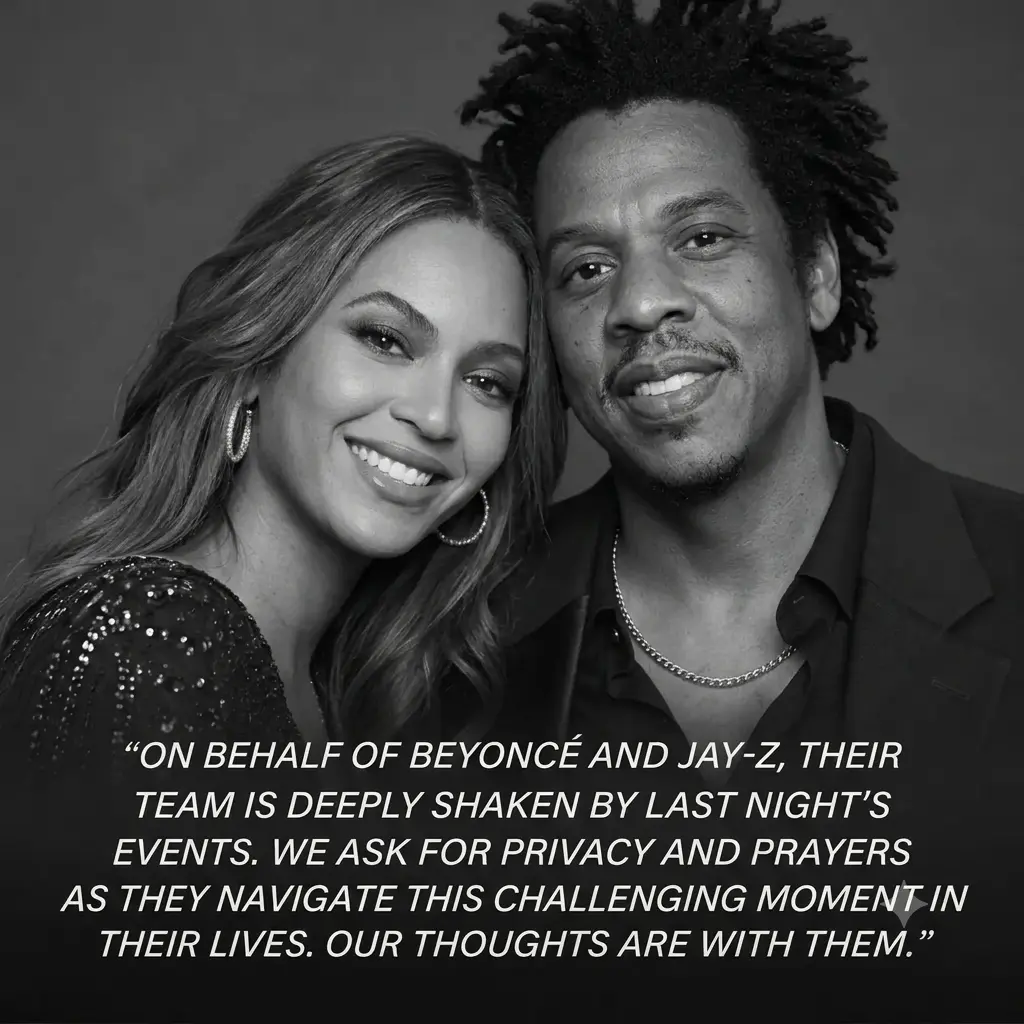
Flashing Lights Outside a Downtown Houston Hotspot
Red and blue patrol lights cut across the wet asphalt outside an exclusive downtown Houston nightclub just after 1:45 a.m., freezing traffic along the block as bystanders raised their phones in disbelief. Moments later, local police officers formed a tight perimeter around the private side exit while Beyoncé emerged beside her personal security detail, escorted swiftly toward a waiting black SUV. Within minutes, grainy clips of the police presence began circulating online, fueling frantic speculation across social media. Yet behind the dramatic sidewalk escort lay an unexpected venue penalty and a hidden motive that completely reframes what happened inside.
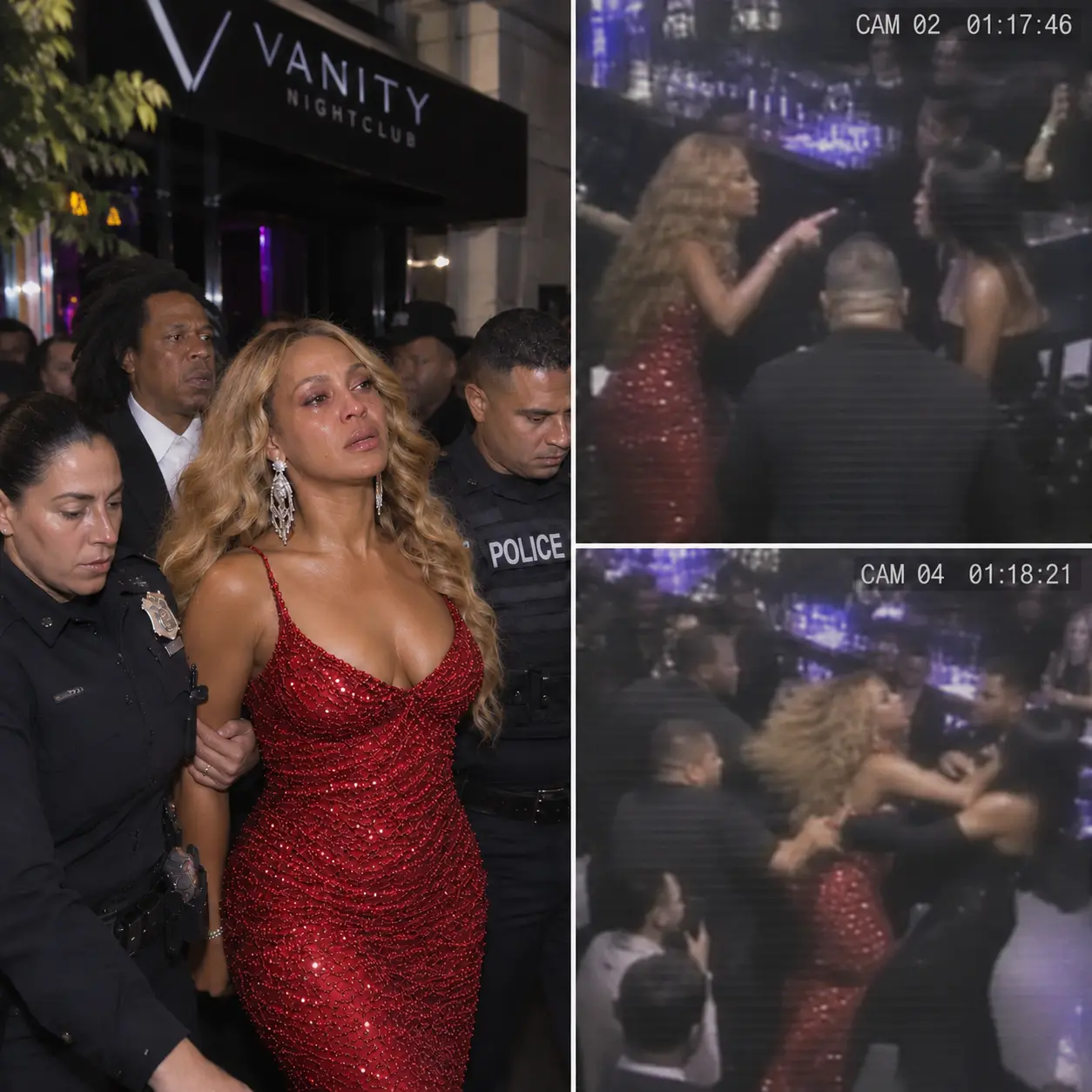
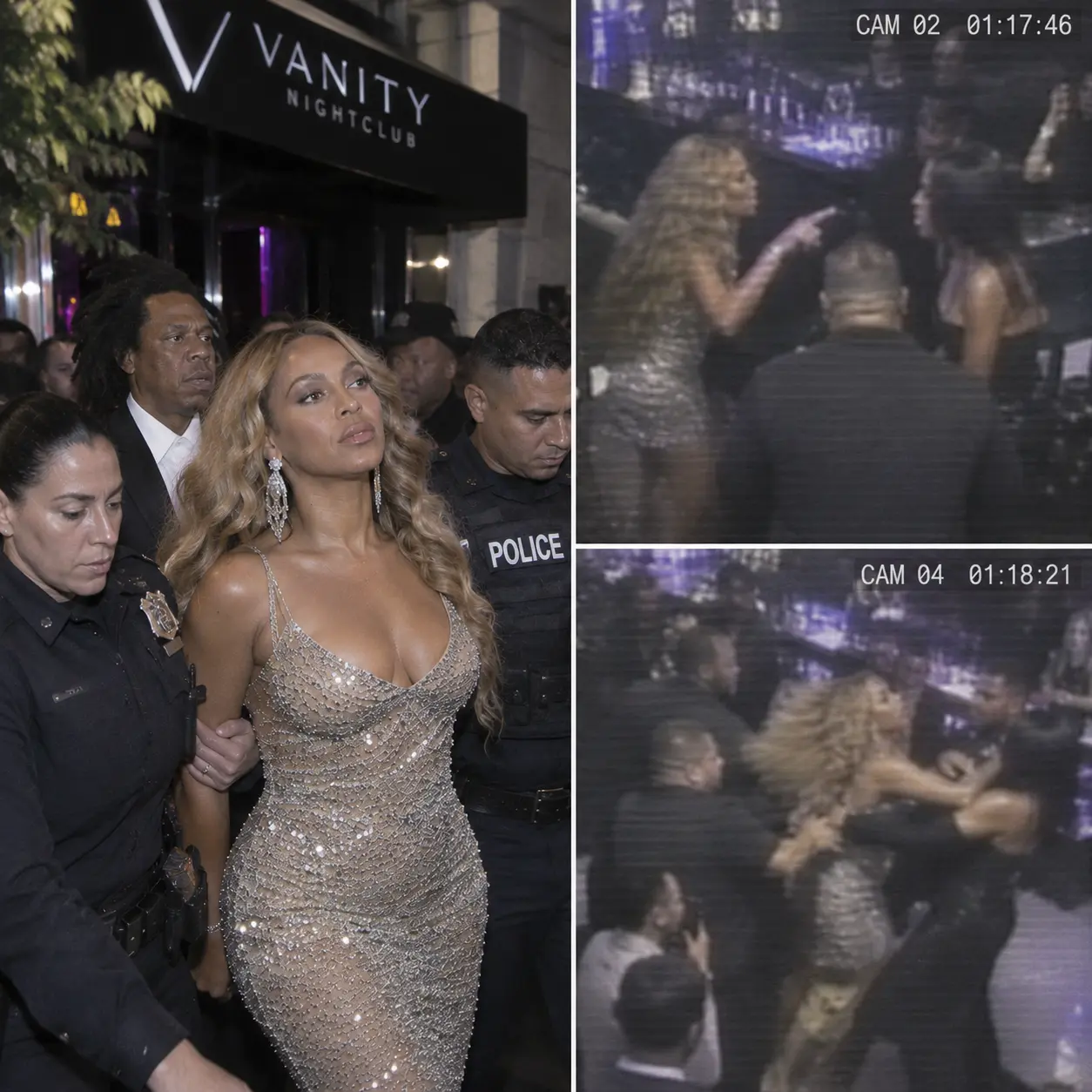
Beyonce was escorted out of the downtown Houston venue shortly after police arrived on scene.
Inside the Velvet-Roped Houston Lounge
Earlier that night, the atmosphere inside the upscale Houston venue had been celebratory, private, and tightly controlled. Beyoncé had arrived quietly with a small circle of longtime friends and family associates following a private hometown gathering, settling into an elevated, velvet-roped VIP alcove tucked away from the main dance floor. Low amber lighting, curated R&B tracks, and discreet bottle service set an effortless tone as guests toasted out of public view. Under strict house rules prohibiting unauthorized photography inside the VIP mezzanine, the evening appeared to be unfolding without a hint of friction—until one nearby booth quietly breached that boundary.
The confrontation erupted inside a private VIP section meant to shield guests from cameras.
The Insult That Sparked a Sudden Confrontation
The flashpoint began when a patron seated in an adjacent VIP booth repeatedly angled a smartphone through the velvet partition, secretly recording Beyoncé’s table without permission. When a member of Beyoncé’s entourage noticed the glowing lens and calmly asked the guest to put the phone away, the individual refused—escalating the exchange with loud, derogatory remarks aimed directly at Beyoncé’s family and children. Within seconds, voices rose above the bassline as members of Beyoncé’s circle stepped forward to block the camera and demand the footage be deleted on the spot. Shoving broke out near the guardrail as glasses shattered, forcing house bouncers to rush the mezzanine to separate both groups before the clash spilled onto the main floor.
Police Step In to Clear the Mezzanine
Because the commotion triggered an automatic venue security protocol, off-duty officers working perimeter detail radioed for local patrol units to assist in clearing the upper level safely. Within minutes, uniformed Houston police officers entered the club, separated the two parties, and interviewed floor managers while reviewing overhead security feeds. Rather than letting crowds mob the main entrance, officers escorted Beyoncé and her party down a private service corridor and out through a secured side exit to their vehicles, while detaining the other VIP guest inside for questioning and identification before clearing the alleyway.
Officers secured the perimeter and escorted both sides out separately to prevent further escalation.
A Sweeping Penalty That Surprised Even Insiders
By morning, confusion over official consequences sparked heated debate online—especially once observers separated actual law enforcement outcomes from the nightclub’s internal discipline. Police confirmed that no criminal charges were filed against Beyoncé and no arrests were made following review of the venue’s surveillance cameras. However, the nightclub’s management group issued an uncompromising administrative sanction of its own: a strict twelve-month ban barring all individuals involved in the mezzanine altercation—including Beyoncé’s entourage and the opposing VIP booth—from entering the venue’s VIP section under its zero-tolerance disturbance policy. For a hometown icon to be hit with the exact same twelve-month VIP suspension as the instigator left fans stunned.
The venue imposed an across-the-board twelve-month VIP ban despite police clearing Beyonce of wrongdoing.
The Hidden Reason Behind the Provocation
As full security details emerged, however, the real story behind the confrontation proved far more calculated than a drunken nightclub argument. Investigators and venue staff reviewing the complete internal surveillance timeline discovered that the VIP guest had not been filming casually—the individual had entered the booth specifically hoping to provoke an emotional reaction on camera. Worse still, associates of the patron were already attempting to shop a heavily edited, twenty-second clip to entertainment blogs, stripping out the initial secret filming and the vicious insults aimed at Beyoncé’s family so the footage appeared as an unprovoked outburst by her team. What looked like a sudden scuffle was actually an orchestrated ambush designed to manufacture a payday from manipulated video.
Full surveillance footage revealed the provocation was engineered to capture and sell edited video.
Outrage Over Staged Outrage
Once the truth about the doctored footage began circulating, public reaction swung sharply from shock to outrage—not at Beyoncé, but at a predatory culture where strangers bait public figures for viral profit. While the nightclub defended its twelve-month VIP restriction as a rigid, neutral house rule, fans and commentators pointed out the glaring injustice of punishing a mother’s circle equally for defending her family against deliberate harassment. In an era where a selectively trimmed phone clip can rewrite reality before the truth ever catches up, the Houston incident leaves behind an unsettling warning: when ambush cameras meet edited narratives, protecting basic human dignity becomes a crime in the court of viral clicks.
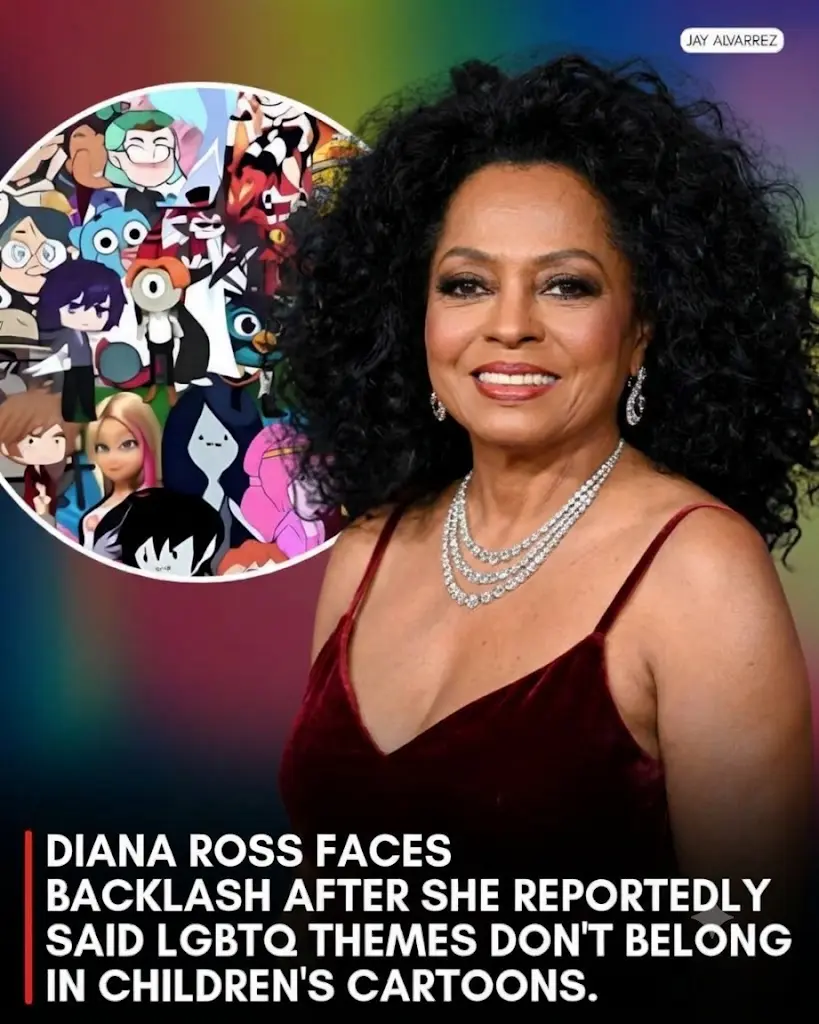
ENTERTAINMENT COMMENTARY — Claims that Diana Ross made controversial comments about LGBTQ representation in children's cartoons have not been independently verified. This article examines the broader cultural debate without presenting unconfirmed statements or criticism as established facts.
Diana Ross has spent more than six decades captivating audiences with her extraordinary voice, unforgettable performances, and enduring influence on popular music.
From her groundbreaking years with The Supremes to her remarkable solo career, the legendary singer has become a symbol of artistic excellence and cultural transformation.
But a circulating claim involving her alleged comments about LGBTQ representation in children's cartoons raises questions about how quickly celebrity-related controversies can spread.
The subject touches on several issues that frequently generate passionate discussion: creative freedom, parental choice, inclusion, and the messages presented to younger audiences.
Yet one essential distinction must be established immediately.
No independently verified statement has been identified demonstrating that Diana Ross made the alleged remarks about LGBTQ representation in children's animation.
Without an authenticated interview, recording, official statement, or reliable report, it would be misleading to describe the singer as having taken a particular position or facing a confirmed backlash over it.
Nevertheless, the broader debate remains relevant to the entertainment industry.
THE CLAIM BEHIND THE DISCUSSION
The circulating narrative suggests that Ross has attracted criticism following comments concerning LGBTQ characters or themes in animated programs intended for children.
However, the allegation does not identify a specific verified quotation or establish where the supposed remarks were made.
That matters because celebrity names can dramatically increase public attention.
A headline involving a legendary performer may spread quickly, especially when it concerns a subject that already inspires strong opinions.
Some readers may immediately agree with the alleged statement.
Others may strongly disagree.
Still others may share the claim simply because it sounds surprising.
But public interest does not establish accuracy.
Before describing a celebrity as being involved in a controversy, responsible reporting must determine what the person actually said.
WHY CHILDREN'S CARTOONS HAVE BECOME A CULTURAL FLASHPOINT
Children's animation has changed considerably over the past several decades.
Traditional cartoons often focused on adventure, comedy, friendship, and simple moral lessons.
Modern programs continue to explore those themes while introducing characters from a wider range of backgrounds.
Some feature different family structures.
Others include characters with disabilities, diverse cultural identities, or LGBTQ family members.
Supporters of this development believe children's entertainment can help young viewers understand the diversity of the communities around them.
They argue that respectful representation can encourage empathy and reduce feelings of exclusion.
For children who have LGBTQ parents, relatives, or friends, seeing similar families represented in entertainment may provide a sense of recognition.
Advocates also emphasize that portraying LGBTQ people does not automatically involve mature subject matter.
A story featuring two parents caring for their child, for example, can be presented through the same age-appropriate themes of love, family, and responsibility found in other children's programs.
WHY SOME PARENTS HAVE QUESTIONS
Other audiences approach the issue differently.
Some parents believe they should have greater control over when and how particular social topics are introduced to their children.
They may prefer programs focused primarily on humor, imagination, music, and familiar educational lessons.
Others want clearer information about the themes presented in animated shows so they can make choices based on their children's ages and individual needs.
These preferences can reflect different cultural, religious, or personal beliefs.
However, concerns about age suitability should not automatically be equated with hostility toward LGBTQ people.
Likewise, supporting inclusive representation does not necessarily mean believing every subject belongs in every children's program.
The challenge is to distinguish thoughtful conversations about age-appropriate storytelling from sweeping judgments about whether certain people or families should be represented at all.
 DIANA ROSS'S REAL ENTERTAINMENT LEGACY
Diana Ross was born in Detroit, Michigan, in 1944.
She rose to international fame as the lead singer of The Supremes, one of Motown's most successful groups.
Songs such as Where Did Our Love Go, Baby Love, Stop! In the Name of Love, and You Can't Hurry Love helped define an era.
Ross later launched a highly successful solo career.
Her recordings include Ain't No Mountain High Enough, Touch Me in the Morning, Love Hangover, and I'm Coming Out.
She also earned acclaim for her acting work, including her portrayal of Billie Holiday in Lady Sings the Blues.
Throughout her career, Ross has maintained a broad and diverse audience.
Her music has also held particular significance in LGBTQ communities, with songs such as I'm Coming Out becoming enduring anthems of self-expression and celebration.
That cultural history is relevant context when evaluating claims about her supposed views.
But it does not establish that she made the specific remarks alleged in the circulating narrative.
Her actual statements should be distinguished from unsupported quotations attributed to her.
THE ROLE OF CREATIVE FREEDOM
Creative freedom has long been central to entertainment.
Writers, directors, animators, and producers make artistic decisions about the stories they want to tell.
Some children's programs are designed primarily to entertain.
Others aim to teach lessons about friendship, cooperation, kindness, or social understanding.
Many attempt to accomplish both.
A diverse entertainment landscape can accommodate different creative approaches.
Families can choose programming that reflects their preferences.
At the same time, creators can develop stories featuring characters from different backgrounds and communities.
Disagreement over a particular show does not automatically require excluding an entire category of characters.
More productive conversations often focus on specific content, intended audiences, and storytelling quality.
HOW AN UNVERIFIED CLAIM CAN BECOME A VIRAL CONTROVERSY
Imagine a social-media user encountering a dramatic headline suggesting that a famous singer has made controversial remarks about children's cartoons.
The headline combines three elements likely to attract attention.
A recognizable celebrity.
A sensitive cultural subject.
And the suggestion of widespread public criticism.
Even without supporting evidence, that combination may encourage immediate reactions.
One account repeats the allegation.
Another adds commentary.
A third presents the claim as though it has already been established.
Soon, thousands of people may be discussing a supposed controversy without knowing whether the original statement exists.
This is why source verification matters.
A credible account should identify when a statement was made, where it appeared, and what was actually said.
It should also preserve the relevant context.
Without those details, an allegation remains unverified regardless of how widely it circulates.
WHY REPRESENTATION MATTERS TO MANY VIEWERS
For supporters of LGBTQ inclusion, representation is often connected to the desire to see different families and experiences treated with dignity.
Children's entertainment has historically introduced young audiences to unfamiliar situations through storytelling.
Characters learn to cooperate.
They overcome misunderstandings.
They discover the importance of kindness.
Inclusive stories may extend those lessons by portraying people whose lives differ from those of the viewer.
Advocates argue that respectful representation can help children understand that differences do not make someone less deserving of friendship or acceptance.
They also emphasize that LGBTQ people are part of real families and communities.
Their presence in a story does not automatically make that story inappropriate for children.
As with other subjects, suitability depends on how the material is presented and the age group for which it is intended.
PARENTAL CHOICE AND RESPONSIBLE STORYTELLING
Parents and guardians play an important role in children's media experiences.
They understand their children's developmental needs, interests, and sensitivities.
Some families watch programs together and discuss the themes afterward.
Others use age ratings, parental guides, and program descriptions to make decisions.
Clear information can help families choose entertainment without requiring every household to make identical decisions.
A program that appeals to one family may not appeal to another.
That difference is not inherently a problem.
The challenge arises when individual preferences become sweeping judgments about what all children should be allowed to see.
A varied selection of programming can provide families with meaningful choices while allowing creators to tell different kinds of stories.
HOLLYWOOD'S BROADER RESPONSIBILITY
Entertainment companies face competing expectations.
Audiences want compelling stories.
Parents want trustworthy information about age suitability.
Creators want artistic freedom.
And underrepresented communities want opportunities to see their experiences portrayed respectfully.
Balancing those expectations is rarely simple.
A thoughtful approach requires attention to storytelling, audience age, context, and representation.
It also requires recognizing that disagreement can occur without hostility.
People can question a creative decision without attacking the identity of the characters or audiences involved.
Likewise, creators can explain their artistic choices without assuming that every concerned parent has the same motivations.
The quality of the discussion matters as much as the subject itself.
WHAT ABOUT THE REPORTED CRITICISM OF DIANA ROSS?
The alleged controversy described in the circulating narrative lacks a verified foundation.
No authenticated quotation has been established here.
No documented interview has been identified.
And no reliable evidence has been provided demonstrating that Ross made the supposed comments.
Therefore, it would be inappropriate to invent her position, describe a fictional public response as real, or claim that a confirmed wave of criticism has occurred.
Her name may attract attention to the broader issue, but the underlying facts must still be established.
That is especially important when a claim concerns a sensitive topic capable of affecting public perceptions of an identifiable person.
THE QUESTION THAT MATTERS MOST
As entertainment continues to evolve, debates about representation and parental expectations are unlikely to disappear.
New animated programs will introduce new characters.
Families will continue making choices about what their children watch.
And creators will continue exploring how storytelling can reflect different experiences.
Those discussions deserve accuracy and respect.
They also deserve a clear distinction between genuine public statements and allegations that have not been substantiated.
For Diana Ross, the immediate question is not whether audiences agree or disagree with a supposed position.
It is whether there is reliable evidence that she expressed that position at all.
Until such evidence is available, the controversy should not be presented as confirmed.
THE FINAL TAKEAWAY
The debate over LGBTQ representation in children's cartoons involves meaningful questions about inclusion, creative freedom, age-appropriate storytelling, and parental choice.
Different audiences may reach different conclusions about individual programs.
But those differences should be discussed through evidence, context, and respect.
A famous name should never substitute for verification.
And an unconfirmed quotation should never become the foundation for a manufactured scandal.
"THE MOST IMPORTANT QUESTION ISN'T HOW LOUDLY PEOPLE REACT TO A CELEBRITY HEADLINE — IT'S WHETHER THE HEADLINE WAS TRUE IN THE FIRST PLACE."
DISCLAIMER: This article is an entertainment commentary piece examining an unverified claim and the broader discussion surrounding LGBTQ representation in children's media. No reliable evidence was provided confirming that Diana Ross made the alleged remarks or experienced the described backlash. The article does not attribute any specific position on LGBTQ representation to the singer. Readers should not interpret the circulating allegation as established breaking news.
#DianaRoss #LGBTQRepresentation #ChildrensEntertainment #CreativeFreedom #EntertainmentNews #fblifestyle #USA